Présentation
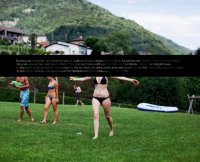
After political power with Protokol, and economic power with Tropical Gift, Christian Lutz turned his attention to religious power with In Jesus’ Name. This third series should have been the conclusion of a trilogy fundamentally political and committed. However, on its publication, the book was banned by the Swiss justice following legal action for violation of their image by persons frequenting the ICF (International Christian Fellowship) and who figured in the book. The controversial images are shown here with a black band, on which are written the complaints as transcribed by the lawyers for the plaintiffs.
The banning of the book of In Jesus’ Name was intended to protect the plaintiffs from perceived violations of their identities by Christian Lutz’s photos. In fact, when we look closely, two possibilities, which could be said to harm the plaintiffs, stand out. On the one hand, interpretations which in reality are not founded on the content of the images, and on the other, situations which are effectively present, but which the ICF refuses to assume (attitudes of trance, games with a military connotation) What in fact is really called into question by this series? The dignity of the persons named as plaintiffs, or the way in which the ICF places them into positions of loss of control of their own image, of their own behaviour? The judicial procedure hasn’t furnished a reply to this question. However, we can see that the problems raised by these images existed long before the photos were taken. The self-image projected by the persons involved in these evangelical meetings is already constituted well before the photographer intervenes, in a scenario whose function is precisely to render visible an intimate attachment to a belief, to give form to the presence of a divine force, by definition invisible. The show of a state of trance, notably, is a determining factor in copycat effects that generate a collective support for the message of faith, and in consequence the loss of distance, of autonomy of the individual faced with the group. The stakes for a tentative total ban on Christian Lutz’s photos were therefore crucial, not for the plaintiffs, but for the structure that embraces them, by the fact that these photos reveal the staging of an emotional state. One possible angle of attack now seems to be to confer on the photographic image the responsibility (in the legal and penal sense of the term) for the interpretations that one could put on these states, despite the fact that everything in their functioning is designed to create the conditions for a latent culpability and a redemptive fervour from which the organisers are able to harvest the fruit in terms of enrolment in the doctrine. It is this staging of pain and rapture as proof of faith that the work of Christian Lutz brings to light, not to condemn the participants, but to reveal its effects.
Prints by Atelier Voies Off - Arles.
With the support from Pro Helvetia, Swiss cultural foundation